It certainly has been March
around here. One day I am sweating and digging post holes, and another I am checking lambs and kids in below freezing temperatures. The wind has been ridiculous, but it dried the surface up just enough that I could dig through the clay. Last summer I struggled to break through the near brick-like clay, and now I find I cannot clean my boots.
There are the beginnings of leaves on the willows and multi-flora rose, and the grass is finally starting to show a little color. I heard peep frogs over in Parker and also in Turkey City, though not here. Because of our terrain, our creeks move a bit too fast and stay a bit too cold until later. We mostly attract later tree frogs, and they spend much of the spring and summer enjoying our troughs and puddles.
On Sunday I saw our first actual dandelion, but surprisingly still haven't seen the coltsfoot which usually blooms a bit earlier and is sometimes confused for dandelion. No less than Pliny himself had trouble figuring out the coltsfoot. He thought that it's flowers and its leaves (which come up much later) were of different plants. He did say it was good for late winter coughs and colds, but I reckon his springs came a bit earlier than ours.
We relish the bitter greens of the dandelion, especially with a bit of bacon grease, onion and vinegar. My Grandma always said it got your digestion ready for the summer. Grandpa said he preferred to wait for the flowers and make his into in wine, to which Grandma would make a face and say nothing more - at least in front of us.
We're a little late to do it now, but on snowy spring mornings Grandpa would sometimes send us up into the woods to find sassafras to dig. We'd get a couple of chunks of root, wash them out in a creek and take them back to the house where Grandma would boil us a red tea with a little milk and sugar. I don't know if it was really a "spring tonic," or if perhaps it was just forcing us out of the house "to get your stink blowed off you," but we liked the tea anyway.
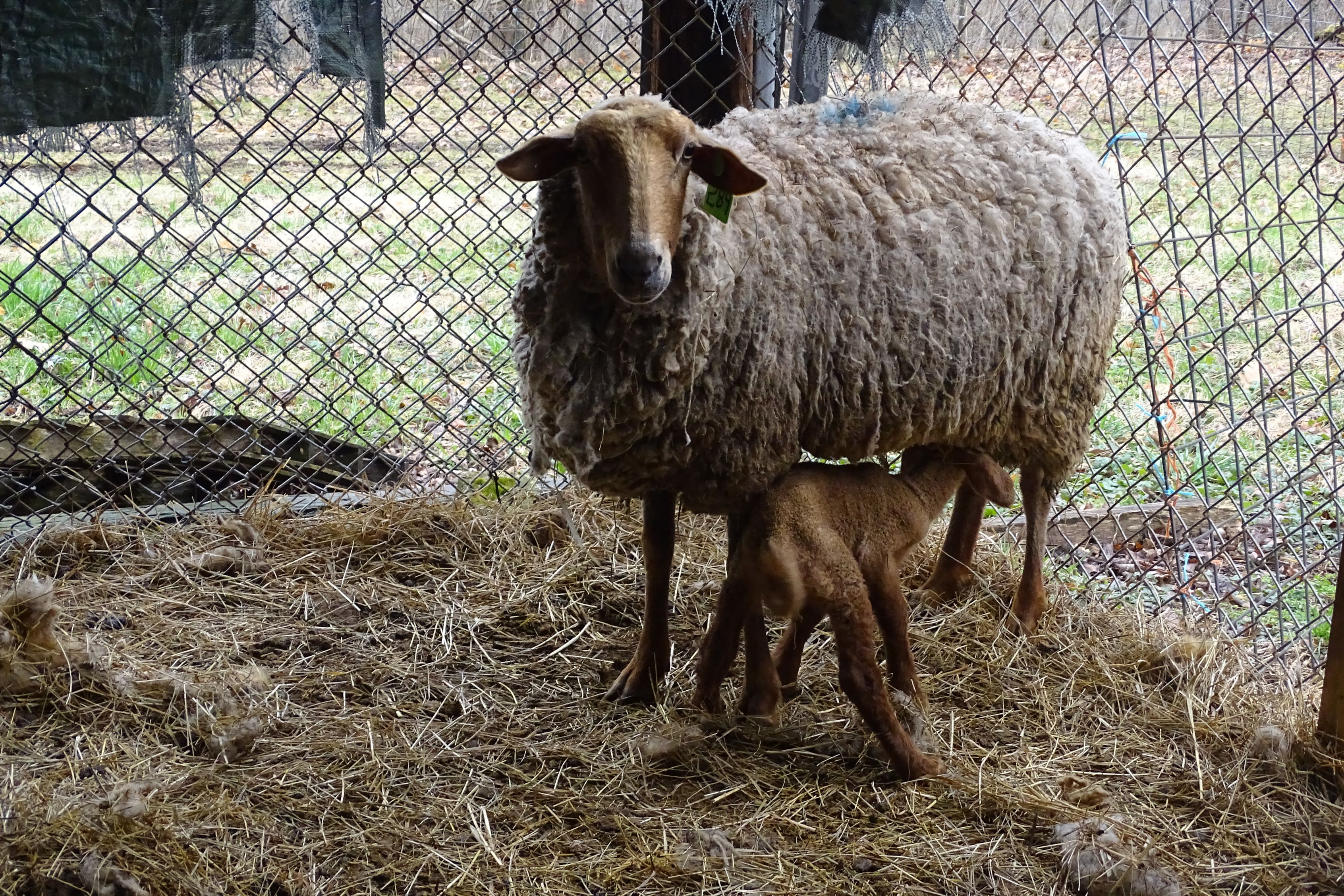
The little fellow pictured above is the first full Tunis we have had born on the farm. He is only maybe an hour or two old in this picture. We have had mostly Cheviots here, although we have had a few partial Tunis in the past, and were very pleased. They tend to behave better than our lively Cheviots (most sheep do), and they fatten well. We hope to get a full Tunis flock going here parallel to our Cheviot flock.
The American Tunis sheep are descended from a small flock given as a gift to President Jefferson by the Bey of Tunis in around 1806. This was back when the capital was in Philadelphia. Jefferson was far from his home in Virginia, and so the flock was entrusted to Judge Richard Peters, a founding father, to raise out on his estate near the city. At one time, he owned much of the land that became our little town. The "Saint" part of our town name was added later because there was another Pennsylvania town also named Petersburg.
Tunis sheep became Jefferson's favorite for both wool and meat, although his Merinos eventually won out on the wool quality front (although i hear it was close). They quickly became the most numerous breed of sheep in America, largely on the east and in the south. They came nearly to extinction during the American Civil War. Although recognized as an endangered heritage breed today, they are not yet as common as many other breeds.
Well, if my history lesson hasn't put you to sleep, I'll just note that when I started this letter it was in the mid 60s and sunny. At the moment it is snowing hard and there is maybe an inch on the ground already.
With all of the signs, I had been convinced it was spring...
Thanks for Listening,
Dave
"Nature never deceives us; it is we who deceive ourselves." -
Jean-Jacques Rousseau |